
The new NPPF gives substantial weight to homes which meet evidenced accommodation needs. Outside settlements, an evidenced unmet affordable housing need can go further: it can trigger Policy S5(1)(j) and engage the presumption in favour of sustainable development itself.
The significance of that shift is heightened by the position we are starting from: decades of accumulated unmet need. The new policy is undoubtedly a step forward. The more difficult question is: after so many years of failing to meet the housing needs of both present and future generations, is substantial weight enough?
What are we actually trying to achieve with sustainable development?
“Sustainable development” is one of those phrases used so routinely in planning that it risks becoming wallpaper. It is worth going back to first principles.
The UN’s Brundtland definition describes sustainable development as development which meets the needs of the present without compromising the ability of future generations to meet their own needs[1].
That concept is carried through into the NPPF. Paragraph 15 in Chapter 1 confirms that the purpose of the planning system is to contribute to sustainable development, while paragraph 17 sets out its economic, social and environmental objectives.
The social objective at paragraph 17(b) seeks to ensure that a sufficient number and range of homes can be provided to meet the needs of present and future generations. Two words matter particularly here: needs and generations.
Are we providing enough homes? Are we providing the right homes? And are we meeting the needs of those who need housing now, rather than simply carrying that unmet need forward? On affordable housing, it is difficult to argue that we have been.
A long history of not meeting housing need
England’s housing crisis did not arrive with the latest NPPF, the first NPPF, or even the modern planning system.
In 1951, Winston Churchill’s incoming Government made building 300,000 homes a year a national priority. By 1953 that rate had been achieved. More than seven decades later, 300,000 homes remains a familiar political benchmark, but England has not exceeded it since 1969 (yes, the moon landings).
The warnings since then have hardly been subtle. The Barker Review concluded in 2004 that England suffered from a persistent inadequate supply of housing. Ten years later, the Home Builders Federation estimated that the accumulated deficit was already approaching 1.45 million homes. In 2018, research for Crisis and the National Housing Federation concluded that around 340,000 homes a year were required, including 145,000 affordable homes.
And still we fell short. Between 2016/17 and 2024/25, net affordable housing additions totalled around 379,000 over the nine year period, against that 145,000-per-year benchmark. The cumulative shortfall was more than 926,000 affordable homes in nine years. In no year did delivery reach even 40% of the identified benchmark.
This is not a temporary mismatch. It is a structural failure to meet need over decades. Yesterday’s unmet need becomes today’s backlog. Today’s backlog becomes the next generation’s housing crisis.
The national picture is difficult to ignore
The consequences are visible across almost every measure of housing stress. More than 1.3 million households are on Housing Registers nationally. Hundreds of thousands of households are owed homelessness duties each year, while increasingly large numbers of families and children remain in temporary accommodation.
Councils spent around £2.84 billion on temporary accommodation in 2024/25, almost twice the level recorded five years earlier. Yet around 96% of that expenditure went towards privately managed forms of provision rather than accommodation owned by councils or housing associations.
At the same time, affordability remains deeply stretched. House prices remain many multiples of earnings nationally, placing ownership out of reach for large numbers of households and increasing pressure on the rented sectors.
These datasets measure different things. A Housing Register is not the same as a homelessness statistic. Temporary accommodation is not the same as an affordability ratio. But that is precisely the point. Housing need is multi-dimensional.
An authority can appear healthy against one housing metric and still be experiencing acute affordable housing stress. And that is where the August 2026 NPPF becomes particularly interesting.
A new presumption - and a default “yes” for sustainable development
The familiar paragraph 11(d) formulation of the presumption in favour of sustainable development has gone. The presumption itself has not. Policy S3 now expressly provides that decisions should apply a presumption in favour of sustainable development, directing proposals within settlements to S4 and those outside settlements to S5.
This represents a material change from the former paragraph 11(d) test. The former test asked whether any adverse impacts would “significantly and demonstrably outweigh the benefits”. The policy wording now instead asks whether the benefits are substantially outweighed by the adverse effects.
The change flips the way in which the balance is expressed. Where the relevant policy is engaged, the starting point is not neutral. The position begins from approval and asks whether adverse effects are sufficiently weighty to overcome the benefits by a substantial margin. If they do not, the proposal should be approved. It therefore amounts, in effect, to a default "yes".
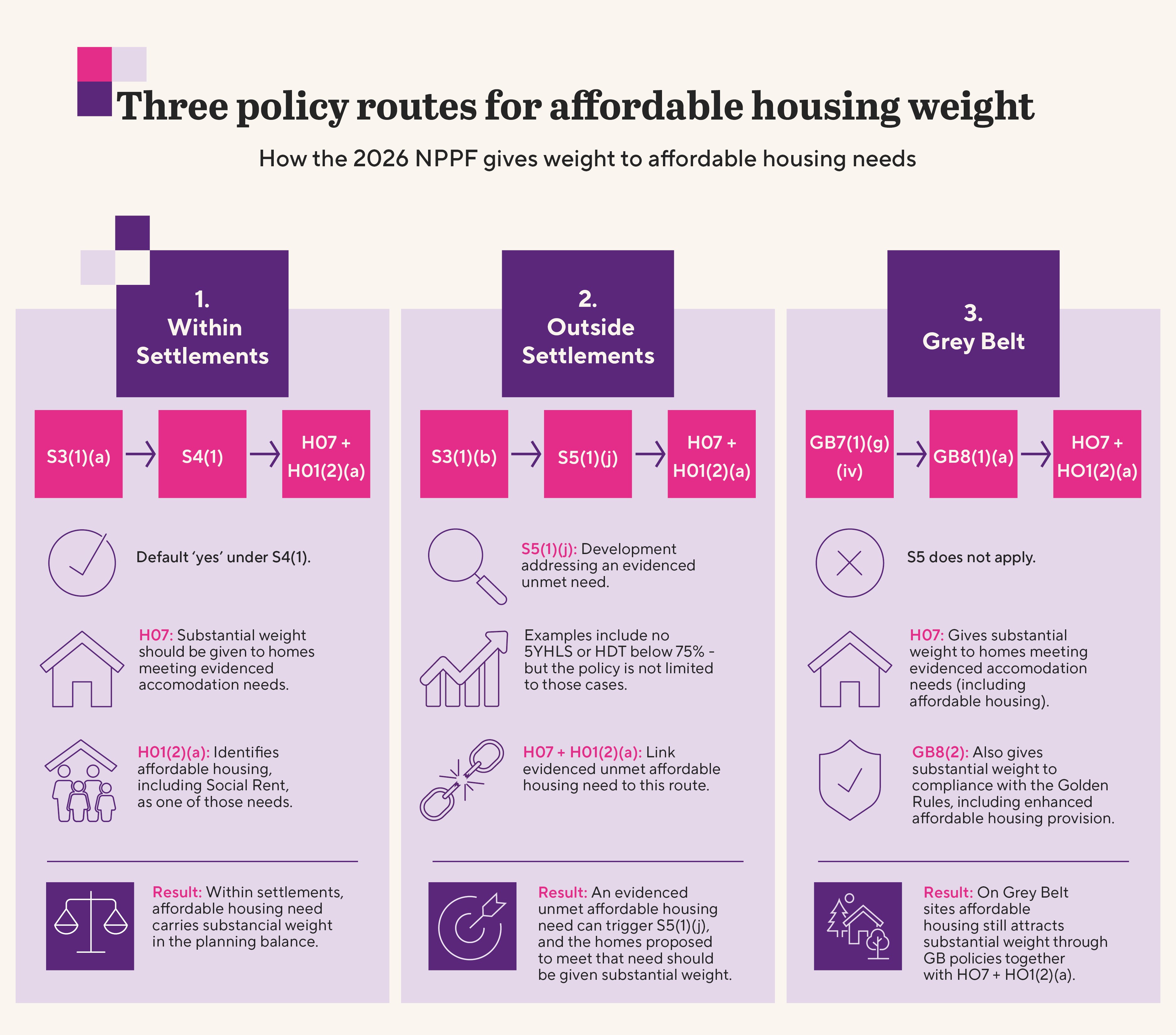
And because these are National Decision-Making Policies (NDMPs), they apply now. Annex A confirms that the policies in the Framework are material considerations which must be taken into account from the day of publication. For affordable housing, there are three particularly important routes through that framework.
Option 1: within settlements — S4 + HO7
Within settlements, S3(1)(a) directs decision-makers to S4. S4(1) provides that development should be approved unless its benefits are substantially outweighed by adverse effects when assessed against the relevant NDMPs.
HO7 then tells the decision-maker how the housing benefits should be treated: substantial weight should be given to homes which contribute towards meeting the evidenced accommodation needs of the community, as identified through needs assessments and other relevant evidence. This includes, but is not limited to, homes needed for different groups assessed under Policy HO1.
Affordable housing, including Social Rent, is one of the needs identified under Policy HO1(2)(a). But the policy reaches considerably further, encompassing older people and care accommodation, disabled people, renters, families with children, students, Travellers, self-build and custom-build and other groups.
Policy HO7 is therefore not just an affordable housing policy. It is a wider instruction to give substantial weight to a range of evidenced accommodation needs. For affordable housing within settlements, the interaction is clear: S4 provides the default "yes", while Policy HO7 directs that meeting evidenced affordable housing need carries substantial weight within that balance.
There are two further important points in the wording of Policy HO7:
- First, evidenced need is not the same as the Local Plan target. An evidence base might identify a need for 800 affordable homes a year, while the Local Plan seeks to deliver only 300 because that is considered achievable through its spatial strategy. The 300 is the plan’s response to the need; it is not the measure of the need itself. Policy HO7 is clear that the test is the evidence of need, not the level of provision the Local Plan has chosen to plan for.
- Second, Policy HO7 is not confined to the headline figure in a formal needs assessment. Its express reference to “other relevant evidence” allows the wider picture to be taken into account. Housing Registers, homelessness, temporary accommodation, affordability, affordable housing delivery and tenure-specific shortfalls can all help demonstrate evidenced unmet need.
As someone who spends a large proportion of my working life evidencing precisely these unmet needs, I know only too well how different that full picture can look from the headline target in a Local Plan.
There is, however, a sting in the tail. Overall housing need has been repeatedly recalibrated through successive versions of the Standard Method, while the methodology for assessing the needs of specific groups, including affordable housing need, has moved far less. As I argued in Planning to Fail, assumptions around affordability, Housing Register eligibility, the private rented sector and households’ ability to meet their own needs can materially suppress the eventual figure.
Without updated guidance on how the needs of specific groups should be assessed, there is also a risk that existing assumptions which suppress need are not only carried forward, but pushed further; using increasingly bold assumptions to reduce identified need and, in turn, keep these new policy triggers from being engaged. One can only hope an updated PPG on the subject is not too far behind.
Option 2: outside settlements — where unmet need can trigger the presumption
Outside settlements, S3(1)(b) directs decision-makers to S5. Of particular importance is S5(1)(j), which applies where development would address an “evidenced unmet need”. For housing, it gives two familiar examples: where an authority cannot demonstrate a five-year housing land supply or scores below 75% in the Housing Delivery Test.
But the crucial words are “including, but not limited to”. Those are examples of unmet need, not an exhaustive definition.
The link to affordable housing is made through HO7 and HO1. HO7 requires substantial weight to be given to homes which meet the evidenced accommodation needs of the community, including the different groups assessed under HO1. HO1(2)(a) expressly includes affordable housing need, including Social Rent.
Read together, the policy chain is clear: S3(1)(b) directs us to S5; S5(1)(j) can be engaged by an evidenced unmet need; and HO7/HO1(2)(a) expressly recognise affordable housing as one such need.
An evidenced shortfall against affordable housing need can therefore satisfy the S5(1)(j) trigger. It is not simply an additional benefit once the presumption is engaged; it can be the reason the presumption is engaged in the first place.
For affordable housing, this is particularly significant because an authority may demonstrate five years of housing land and comfortably pass HDT while still having a persistent shortfall against its objectively assessed affordable housing need and/or other indicators of unmet affordable housing need.
Some examples illustrate the point:
- Wakefield – HDT of 112% and a claimed 5.5-year supply, yet 27,496 households on the Housing Register, 37% of which included at least one dependent child.
- Wandsworth – HDT of 123% and a claimed 5.5-year supply, yet 3,614 households in temporary accommodation, including 3,582 children, with 94% housed outside the borough.
- Nottingham – HDT of 108% and a claimed 11.14-year supply, yet £12.484 million spent on temporary accommodation last year, more than half on nightly-paid private-sector accommodation.
- Brentwood – HDT of 110% and a claimed 5.18-year supply, yet a median affordability ratio of 12.88, associated with a median house price of £500,000.
- Vale of White Horse – HDT of 192% and a claimed 5.51-year housing land supply, yet a shortfall of almost 600 affordable homes in the first five years of the most recent assessment.
These indicators measure different things, but they illustrate a simple point: passing the conventional housing supply tests does not mean housing need is being met. Affordable housing therefore plays two connected roles: an evidenced shortfall can engage S5(1)(j), while HO7 requires substantial weight to be given to the homes proposed to meet that need.
That interaction between S3(1)(b), S5(1)(j), HO7 and HO1(2)(a) is one of the most consequential affordable housing changes in the new Framework.
Option 3: Green Belt — a different route
Grey Belt development needs separate treatment because S5 expressly does not apply. Whilst GB7(1)(g)(ii) requires an evidenced unmet need, Footnote 41 identifies the housing trigger as either the absence of a 5YHLS or HDT performance below 75%. The wider S5(1)(j) route therefore does not simply carry across.
Although arguably, if evidenced unmet affordable housing need is capable of engaging S5(1)(j), it should also be capable of constituting the evidenced unmet need required by GB7(1)(g)(ii).
Irrespective of how that point is ultimately interpreted, affordable housing remains particularly important in the planning balance. HO7 still applies and requires substantial weight to be given to homes meeting evidenced accommodation needs.
GB7(1)(g)(iv) is clear that, for major housing development to which GB8 ‘The Golden Rules’ applies, substantial weight should separately be given to the importance of complying with the Golden Rules, including the enhanced affordable housing provision required by GB8(1)(a).
It would be wrong simply to double-count the same affordable homes. But the policy signal is clear. Government has deliberately used its strongest express weighting language both for meeting evidenced accommodation need and for compliance with the Golden Rules.
The graphic below illustrates the three key policy routes through which the new NPPF gives weight to affordable housing need in decision-making.
So, where does that leave us?
There is much to welcome. Within settlements, S4 provides a default “yes” and HO7 gives substantial weight to meeting evidenced accommodation need. Outside settlements, an evidenced affordable housing shortfall can go further and trigger S5(1)(j). In the Green Belt, affordable housing sits at the heart of both HO7 and the Golden Rules.
Perhaps most importantly, the Framework points us back to the need itself. Not the number a Local Plan decided it could realistically deliver. Not whether an authority passed HDT. Not whether it can demonstrate a five-year supply. The need.
Behind every annual shortfall are households whose housing needs have not been met: families in temporary accommodation, children without the security of a settled home, older and disabled people living in unsuitable accommodation, and households watching a secure home move further out of reach.
Those needs do not disappear because an authority passes HDT, identifies five years of housing land or plans to meet only part of its assessed affordable housing need. They accumulate.
That takes us back to paragraph 17(b). Sustainable development is supposed to meet the needs of present and future generations.
The August 2026 NPPF gives decision-makers stronger tools to do that. The real measure of success will not be how often HO7 is cited or S5(1)(j) debated. It will be whether the people identified by our housing evidence actually get the homes the evidence says they need.
Because otherwise, we will continue doing what we have done for decades: measuring unmet need, documenting unmet need, and passing it on to the next generation.
For further information on the implications of the NPPF for affordable housing and other specialist housing needs, please contact Annie Gingell.
25 August 2026
[1] Resolution 42/187 of the United Nations General Assembly
